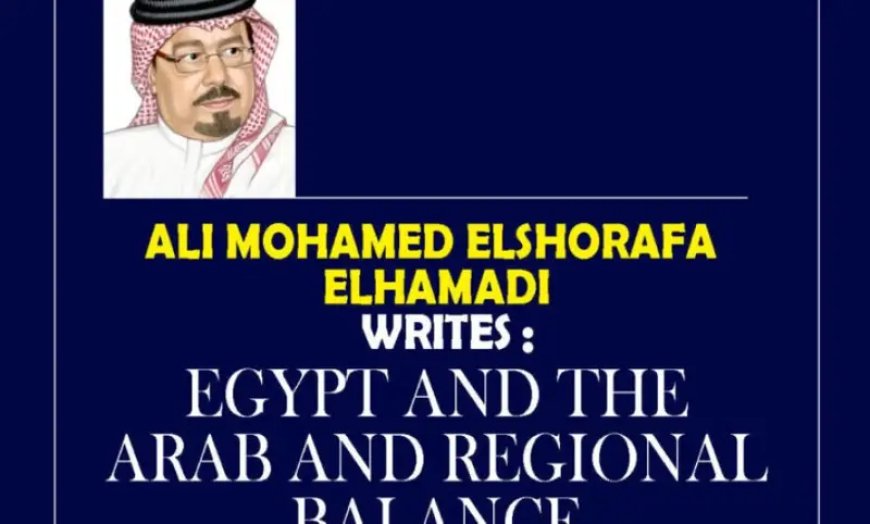
Al-Shorafa Al-Hammadi: Egypt and the Arab and Regional Balance
History has taught us the positions of the honorable Egypt, which deals with the Arabs by treating the real brother, and stands with them in all their cases without price, grace, or political or material interest. Rather, it derives its Arab values from a long history proven by blood, money, race, and struggle, and the sacrifices of its peoples with their blood for the sake of Arab issues. This is its political, geographical, and national destiny, as it is the heart in the crumbling Arab body which wrestles over the most trivial matters.
When I contemplate the history of the Arab nation in its great moments of collapse, I find that Egypt has always been the country that bears the greatest burden in protecting Arab identity, and preserving the rest of the cohesion of this body, which has been subjected over the long decades to organized attempts to tear apart the national state, which targeted dismantling the national country and ignite sectarian, sectarian and ethnic conflicts, so that the whole region turns into open arenas of chaos, war and attrition.
Egypt and the Balance of the Region
Talking about Egypt is not only about geographical borders, population, or military power. It is about a civilizational idea rooted in all human history. This country, which made one of the oldest civilizations in the world, has remained for thousands of years a center of regional balance. When it was weakening, the entire Arab nation was entering into the cycles of turmoil and disintegration. When it was recovering, the entire region was restoring some of its lost balance.
Therefore, it was not surprising that Egypt, throughout its recent history, shouldered burdens that exceeded sometimes its economic and political capacity, in defense of the issues of the Arab nation. From Palestine to Algeria, from Yemen to Iraq, and from Lebanon to Libya, Egyptian blood remained present in all battles to defend Arab national security, and Cairo remained, despite all the pressures and targeting it was subjected to, representing the main focal point in the equation of Arab stability.
Egypt has paid a heavy price for sticking to its national role. It was driven by its economy, its internal stability, and the blood of its sons, because it was aware by virtue of its geographical and historical location that the fall of any Arab country in chaos extends to the entire region, and does not remain confined within its borders. Egyptian national security was never separate from Arab national security, and this fact was proven by geography before politics confirmed it.
Whoever reads the maps of the conflict in the region realizes that targeting Egypt was a targeting of the idea of the central Arab state capable of maintaining balance and was never a targeting of a single state, and that is why Egypt has been subjected over the decades to successive waves of pressures, wars, conspiracies and attempts to weaken, because staying strong means that the idea of the Arab nation itself remains alive and able to resist.
Throughout history, many forces have realized that the overthrow or exhaustion of Egypt represents the most dangerous way to reshape the region according to fragmentation and chaos maps. For this reason, we have witnessed how investment in the establishment of the Brotherhood in the 1920s took place from the heart of Egypt to strike national cohesion, fragment the social fabric, spread extremist groups, finance chaos, and strike national state institutions in a number of Arab countries, with the aim of creating a torn Middle East in which armies turn into militias, states into conflicting sectarian entities, and peoples into fearful, hungry groups seeking only to survive.
At the heart of this storm, Egypt remained the last dam against a total collapse that could have engulfed the entire region. Therefore, the battle was the battle of the entire Arab nation and was never an internal battle for Egyptians alone, because the fall of the Egyptian state would have meant the collapse of the last major centers of equilibrium in the Arab world.
Therefore, I fully understand why Egypt has become a permanent target of smear campaigns, sieges, and attempts to sow despair and frustration within its people. The forces that want to dismantle the region realize that the survival of the Egyptian army, the survival of state institutions, and the survival of the national consciousness alive within the Egyptian people means the failure of the project of total chaos that regional and international groups, organizations, and forces have sought for many years.
Egypt is a country that, by virtue of history, bears a heavy responsibility towards its Arab region and does not seek hegemony as some try to portray it. When it moves to protect its national security, it at the same time protects the entire Arab sphere from collapse. Therefore, the stability of Egypt today represents a strategic necessity for the Arab nation, not because the Egyptians repeat it emotionally, but because the solid facts on the ground proved that the absence of a strong Egypt opens the doors of chaos to everyone.
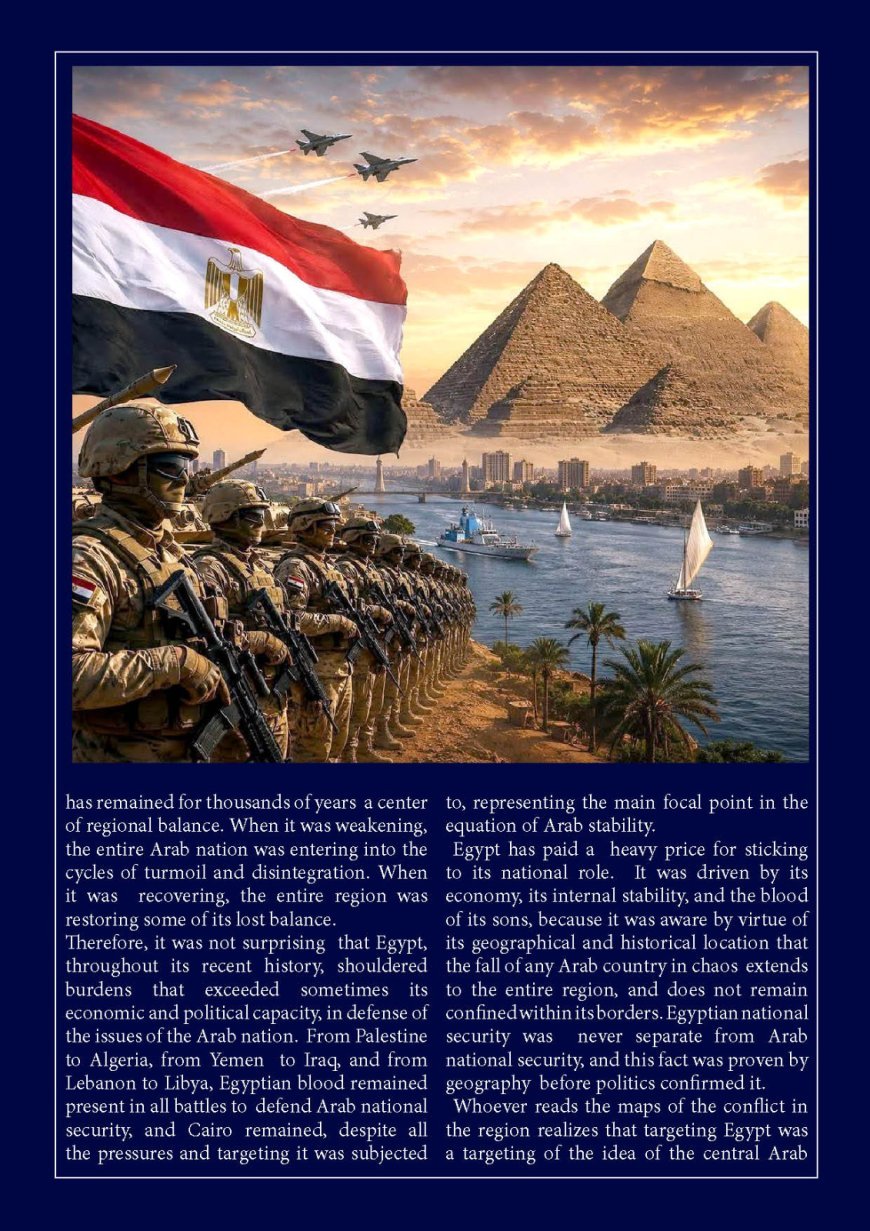
Recent years have revealed the magnitude of the risks that were surrounding the region after some Arab countries turned into open arenas for foreign interventions, armed rebel organizations and internal fighting. In contrast, Egypt has proven that a strong national state, based on a cohesive army, stable institutions and solid popular awareness, remains the last bulwark against partition and collapse projects.
When I talk about Egypt as the beating Arab heart, I am describing a stable strategic fact that is confirmed by the movement of history, geography and politics together. I do not use a structural, enthusiastic or emotional expression. When the heart weakens, the whole body becomes dysfunctional. When it ceases to perform its function, the rest of the members enter into a state of accelerated collapse. Egypt has also been throughout modern Arab history. If crises intensify, the entire region shakes, and if it regains its strength, some balance returns to the Arab world.